
by Suzanne Lieurance
A mentor text is a piece of writing you study — not to copy, but to learn from. It’s the novel you keep on your desk while drafting your own, the essay you reread to figure out how the writer built that ending, the song you play on repeat trying to understand why the bridge hits so hard. Professional writers do this constantly, even when they don’t call it by name.
Here’s the thing nobody tells you when you’re starting out: original voice doesn’t come from avoiding influence. It comes from absorbing enough of it that something new gets pressed out the other side.
Why Working Writers Lean on Mentor Texts
Think about it this way. A novelist studying pacing might sit with a thriller she admires and map out, chapter by chapter, where the tension spikes. A poet might retype someone else’s poem by hand, just to feel the line breaks in her fingers. It’s not plagiarism — it’s closer to an apprenticeship. You’re asking the text: how did you do that? And then you go do something that’s yours.
This is exactly why craft books tell you to read widely in your genre before you try to write in it. You’re not looking for what to say. You’re looking for how saying-it works.
How I’m Using Mentor Texts in My Songwriting
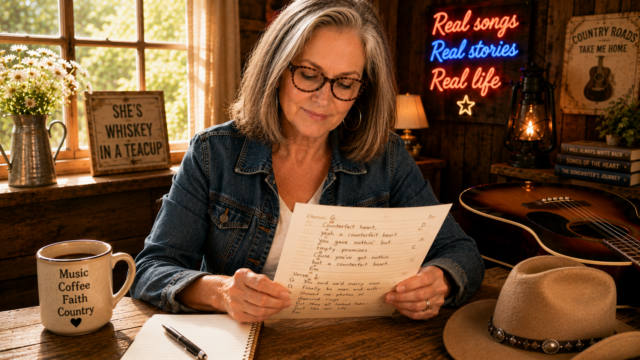
I’ve started doing this deliberately with my country music. When I sit down to write a song — whether it’s a heartbreak ballad or something with a little more bite, like “Lady Stetson” — I’ll often pull up a song I love in that same emotional lane first. Not to borrow the words. To borrow the architecture. Where does the writer plant the first clue? How long do they wait before the twist lands? Does the chorus arrive early to hook you, or hold back to make you wait for it?
With “Counterfeit Heart,” I studied songs that use an extended metaphor the way I wanted to use the currency image — tracking how other writers keep a single metaphor alive across three verses without it going stale. With character-driven songs like the ones built around a reveal, I’ve gone back to classic country storytelling structures to see how the payoff gets earned instead of just announced.
None of this means the final song sounds like the mentor text. It usually doesn’t, once I’m a few drafts in. What changes is that I’ve internalized a move — a way of building tension, a way of trusting silence before the payoff — and now that move belongs to me, filtered through a Memphis-and-Nashville ear and whatever story I’m actually trying to tell.
Try It Yourself
If you write anything — fiction, essays, songs — pick one piece you genuinely admire and get nosy with it. Don’t just read it. Interrogate it. What’s the writer doing in the first line to earn your attention? Where’s the turn? What are they willing to leave unsaid?
Then close it, open your own blank page, and write. Not their story. Yours. But with their fingerprints quietly on the tools you just picked up.
Because that’s the real secret about influence: it’s not a shortcut around originality. It’s usually the road that leads there.
Follow along on my songwriting journey at YouTube.
 Suzanne Lieurance is the author of over 40 published books and a transformational Law of Attraction coach for writers who are ready to stop waiting to feel like the real thing. At Write by the Sea, she guides writers through the identity shift that changes everything — not just the writing, but the whole life built around it. She is the publisher of Manifesting Monthly magazine and the host of Monday Morning Manifestors.
Subscribe to The Morning Nudge to get a FREE, short email every weekday morning with writing tips and other resources for writers.



This is a very interesting concept, and I can see where it would make a great tool for writers/authors. I love the questions you provided to understand how the mentor text is used. I think I tried this once but didn’t think about using it again and again. Thanks for sharing this information Suzanne.
Sandra,
I love using a mentor text. Oddly, my work always ends up so much different from the mentor text. But it gives me a guide. Try it again.
Suzanne