Why specificity is the secret — whether you’re writing country lyrics or a children’s picture book
by Suzanne Lieurance
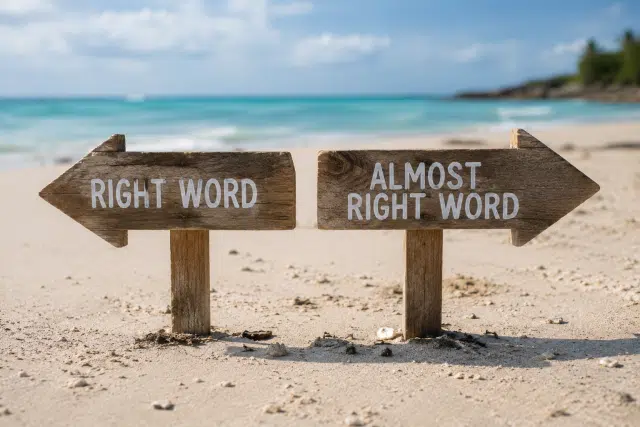
“The difference between the right word and the almost right word is the difference between lightning and a lightning bug.”
— Mark Twain
Mark Twain wasn’t being poetic for the sake of it. He was being precise — which, when you think about it, proves the point entirely. Lightning splits the sky open. A lightning bug blinks in the backyard. Both involve light. Neither one is wrong. But only one of them stops your heart for a second.
That’s what the right word does. It stops you. It makes you feel something before your brain even catches up to explain why.
I’ve been thinking about this a lot lately — specifically in two forms of writing that, on the surface, couldn’t look more different: country music lyrics and children’s picture books. One lives on radio stations and honky-tonks. The other lives on laps and nightstands. But spend time in both, and you start to realize they share the same secret. The same obsession with specificity. The same understanding that general words coast right past us, but the right specific word lodges itself somewhere deep.
Every Word Earns Its Place (or It Goes Home)
A children’s picture book is one of the most ruthless forms of writing I know. You get, at most, a few hundred words to tell a complete story — and those words have to carry weight on every single page. There’s no room for filler. No space for “nice” or “pretty” or “a lot.” Every word has to pull its full weight, or it doesn’t get to come along.
Instead of “the dog was big,” you write “the dog was the size of a sofa.” Instead of “she felt sad,” you write “she pressed her cheek to the window and watched the rain make rivers.” General words tell the child what to think. Specific words invite them inside the moment — and more importantly, give the illustrator something to actually draw.
“General words tell the child what to think. Specific words invite them inside the moment.”
That’s the part people often forget. In a picture book, the words and the illustrations are in constant conversation with each other. The words can’t just describe what’s already in the picture — that’s redundant, and children know it immediately. The words have to open a door the illustration can walk through. Specificity is what makes that happen. A vague word gives the illustrator nothing to hold onto. A precise word gives them a whole world.
Country Music Does the Same Thing — It Just Does It in 3/4 Time
Country lyrics don’t say “I lost her.” They say “I still set two coffee cups in the morning before I remember.” That’s the difference. One is information. The other is a painting — and the painting is what makes you pull your car over on the highway because something is suddenly sitting on your chest.
The best country lyrics are almost embarrassingly specific. A particular truck. A particular town. A particular night with a particular song on the radio. The kind of specific that makes a listener from a completely different life suddenly feel like the song was written about their own. That’s the paradox of specificity in songwriting: the more precise you are, the more universal it becomes. Because everyone has had their own version of that truck, that town, that night.
WORTH YOUR EARS
Malcolm Gladwell: “The King of Tears” — Revisionist History Podcast
If you’ve ever wondered why country music makes you cry while rock music doesn’t — even when you’re not a particular country fan — Malcolm Gladwell digs into the psychology of it in this episode. He makes a compelling case that it comes down to specificity: the precision of the images, the directness of the emotional language, and the way country music talks about loss without flinching or dressing it up. It’s one of the most convincing arguments for why word choice is never just an aesthetic decision — it’s an emotional one.
Listen to “The King of Tears” on Revisionist History
Verses and Page Turns: The Same Architecture
Here’s the thing I find most fascinating about these two forms: they’re built the same way.
A picture book moves in page turns. Each spread is its own moment — its own beat. The page turn itself is a storytelling tool, a tiny pause that builds anticipation before the reveal. You can’t rush it. You can’t dump everything on one page. The story breathes through the structure.
Country music moves in verses. Each verse is its own scene — a snapshot, a specific moment in the story. Verse one sets the scene. Verse two deepens it or shifts it. The chorus is the emotional truth that keeps returning, the thing the whole song is really about. And the bridge — if there is one — is the turn, the crack in the armor, the moment everything changes.
“The page turn in a picture book and the verse break in a country song are doing exactly the same thing: giving the story room to breathe.”
Both forms know that you can’t sustain emotional intensity without structural breaks. The white space matters as much as the words. Silence — whether it’s the pause before turning a page or the breath between a verse and a chorus — is part of the story. It’s where the listener or reader catches up to what they’re feeling.
And just like a good picture book, a great country song paints pictures with its words because it has to. The melody carries you. The chorus anchors you. But the verses? The verses are the illustrations. They’re where you see the truck in the driveway at 2 a.m., the boots drying on the porch rail, the jar of sweet tea sweating on the counter. You don’t just hear about the story — you stand inside it.
So, What Does This Mean For You?
Whether you’re working on a manuscript for the four-year-olds who will hear this book a hundred times and memorize every word, or you’re trying to write a lyric that makes someone feel less alone on a long drive home — the principle is the same:
Don’t say “she was happy.” Say what happy looked like on her, right then, in that particular light.
Don’t say “he missed the place.” Say what specific thing he missed — the smell of the gas station on the corner, or the way the fog came in low over the field every morning in October.
Lightning versus lightning bug. Every time.
The almost-right word will get you there. But the right word? The right word will get them there — which is the whole point.
Now, what’s the most specific, precise word — or line — you’ve ever written? The one that surprised even you?
Share it here as a comment, below.
Oh, and follow along on my journey as I write lyrics for country songs and turn them into actual music, with some help from AI, at my Youtube Channel. I hope you’ll subscribe – and don’t forget to click the little bell so you’ll be notified each time I post a new song.
 Suzanne Lieurance is the author of over 40 published books and a transformational Law of Attraction coach for writers who are ready to stop waiting to feel like the real thing. She was an instructor for the Institute of Children’s Literature for over 8 years. At Write by the Sea, she guides writers through the identity shift that changes everything — not just the writing, but the whole life built around it. She is the publisher of Manifesting Monthly magazine and the host of Monday Morning Manifestors.