by Suzanne Lieurance
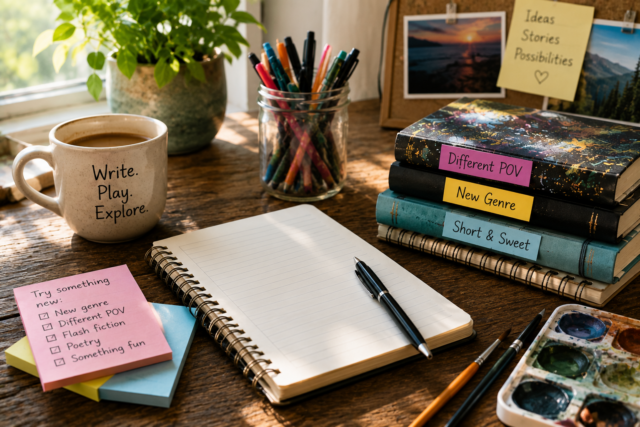
When was the last time you wrote something you had absolutely no plans to publish?
No deadline. No market. No word count requirement. No need to decide whether it was good.
You were simply trying something.
That kind of writing can disappear once you begin taking your writing seriously. You become focused on finishing projects, meeting goals, finding readers, and making your work useful.
All of that matters. But you also need room to experiment.
Not Everything Has to Become Something
One of the quickest ways to shut down experimentation is to demand a purpose before you begin.
You, ask yourself, If I write this, what will I do with it?
Well, maybe nothing.
Perhaps you’ll write three pages in a different genre and decide you don’t enjoy it. Maybe you’ll tell a scene from an unusual point of view and never use the result. You might write a poem, a song lyric, a personal essay, or a piece of flash fiction simply to see what happens.
The experiment can be worthwhile even if the pages never go anywhere.
Experimentation Removes Some of the Pressure
When every writing session is attached to an important outcome, it’s easy to become cautious.
You want the chapter to work. You want the article to be publishable. You want the book to sell.
An experiment changes the rules.
You aren’t trying to succeed. You’re trying to discover.
That shift can make you more willing to take risks with language, structure, voice, subject matter, and form.
Try Something You Don’t Normally Do
If you usually write nonfiction, write a scene between two fictional characters.
If you write novels, tell a complete story in 500 words.
If you always write in first person, try third person. If your writing is usually serious, make something funny. If you plan everything, write a page without knowing where it’s going.
None of this means you should change the kind of writer you are.
You’re simply giving yourself access to tools and possibilities you might not discover by always working the same way.
Bring What You Learn Back to Your Real Work
Experiments have a funny way of teaching us things.
That short piece of dialogue may loosen up the conversations in your novel. Writing a poem may make you more aware of rhythm and word choice. Trying flash fiction may show you how much you can cut from a scene without losing its meaning.
Even an experiment you dislike can teach you something useful.
This connects naturally with our Writing Productivity for Authors pillar page. Productive writing isn’t only about generating more words. Sometimes a short period of playful exploration improves the work you return to afterward.
Protect a Little Creative Play
You don’t need to spend half your week experimenting.
Set aside twenty or thirty minutes. Choose something you’ve never tried, or something you haven’t done in years.
Most importantly, don’t judge the result by whether it’s publishable.
Ask instead: What did I notice? What surprised me? What did this make me want to try next?
Your Next Step
Choose one small writing experiment for this week.
Change the form, voice, length, genre, structure, or point of view.
Give yourself permission to make something strange, messy, funny, unsuccessful, or completely unusable.
You may throw it away when you’re finished.
Or you may discover a part of your writing voice you haven’t been giving enough room to use.
Further Reading
- Our August Writing Challenge: Bold Creative Expansion
- What Are You Curious About as a Writer?
- Stop Treating Your Big Writing Goals as All-or-Nothing
- Writing Productivity for Authors (Pillar Page)
- Monday Morning Manifestors
 Suzanne Lieurance is the author of over 40 published books and a transformational Law of Attraction coach for writers who are ready to stop waiting to feel like the real thing. At Write by the Sea, she guides writers through the identity shift that changes everything — not just the writing, but the whole life built around it. She is the publisher of Manifesting Monthly magazine and the host of Monday Morning Manifestors.
Subscribe to The Morning Nudge to get a FREE, short email every weekday morning with writing tips and other resources for writers. You’ll also get a free e-book, You Are Already a Writer – Now It’s Time to Start Living Like One.