
by Suzanne Lieurance
If you’re wondering how to find writing ideas, one of the richest places to look is your own life. Your jobs, hobbies, skills, relationships, places you’ve lived, problems you’ve solved, and lessons you’ve learned can all become raw material for stories, articles, essays, and books.
That doesn’t mean you need to write your autobiography. It means recognizing that you already carry around a collection of knowledge and experience that no other writer has in exactly the same combination.
Earlier this month, we talked about bringing new inputs into your creative life. That’s valuable. But creative expansion can also happen when you take a second look at what is already there.
You Know More Than You Think You Do
When writers hear the advice “write what you know,” they sometimes assume it means their lives need to have been unusual enough to write about.
They don’t.
Ordinary experience becomes useful writing material when you notice what you’ve learned from it.
Maybe you’ve raised children, moved across the country, worked in a school, run a small business, lived near the ocean, trained dogs, renovated a house, traveled alone, taught a class, grown a garden, or spent years mastering a hobby.
Each experience has given you information, observations, stories, language, emotions, and details that someone without that experience wouldn’t have.
Think Beyond Major Life Events
You don’t need to begin with the most dramatic thing that ever happened to you.
Some of the best material may come from things you barely think about anymore because they’re so familiar.
Think about jobs you’ve held. What did you learn about people there? What situations happened over and over? What did outsiders misunderstand about that kind of work?
Think about places you’ve lived. What did locals know that visitors didn’t? What did the place sound like in the morning? What changed with the seasons?
Think about hobbies and skills. What mistakes do beginners always make? What do experienced people notice that novices miss?
Those details can give nonfiction authority and fiction specificity.
Turn Experience Into Questions
Your experience doesn’t have to become the subject itself.
Instead, use what you know to generate questions.
If you’ve spent years teaching children, you might ask what makes one child persist while another gives up. That question could lead to an article, a nonfiction book, or a fictional character.
If you’ve lived through several hurricanes, you might become interested in how people behave when they’re told to evacuate. That’s different from simply writing about the storm.
Your experience gives you a starting point. Your questions take you somewhere new.
Look for the Knowledge You Take for Granted
The most valuable item on your list may be something you almost leave off because it seems too obvious.
That’s because expertise becomes invisible to the person who has it.
You may know how to organize a complicated project, make a nervous person comfortable, spot a good antique, choose books for reluctant readers, stretch a grocery budget, prepare for a long trip, or recognize when a story isn’t working.
You’ve done it so many times that you assume everyone knows. They don’t.
This is particularly useful for nonfiction writers. A subject that feels basic to you may solve a real problem for someone encountering it for the first time.
Use What You Know Without Being Limited by It
Writing from your own knowledge doesn’t mean staying inside the boundaries of your experience.
You can use the emotional truth of something you’ve lived through in a completely invented situation. You can take your knowledge of one profession and give it to a fictional character. You can begin with something familiar and research your way far beyond it.
Think of your experience as a launch point rather than a fence.
That’s one reason this fits so well with our August Bold Creative Expansion challenge. Expansion isn’t always about finding something completely new. Sometimes it’s about discovering how much creative territory was already available to you.
Make Your Personal Knowledge Inventory
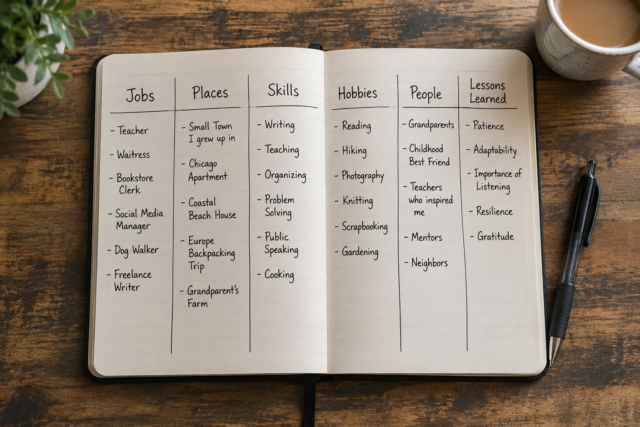
Take a blank page and create six headings: Jobs I’ve Had; Places I’ve Lived or Spent Time; Skills I’ve Learned; Hobbies and Interests; Experiences That Changed Me; and Things People Ask Me for Help With.
Try to put at least five items under each heading.
Then go back through the list and mark anything that makes you think, “There’s something there.”
Don’t worry yet about whether it’s a book, article, story, or something else.
Connect It to the Writing Life You’re Building
Once you have several possibilities, think about which ones fit the direction you want your writing to take.
Our Manifesting a Writing Career pillar page can help you look beyond isolated projects and think about the larger writing career you’re creating. An idea becomes more useful when it connects not only with what you know, but also with where you want to go.
You might also revisit What Are You Curious About as a Writer? from earlier this month. Put your curiosity list beside your personal knowledge inventory and look for places where the two overlap. That intersection—something you already know combined with something you want to explore—can be especially fertile ground.
Your Next Step
Don’t finish this exercise by filing the list away.
Choose one item and spend fifteen minutes exploring what you could do with it.
Ask yourself: What could I teach about this? What story could grow from this? What question does this experience make me want to answer? Who might need to know what I’ve learned?
You don’t need to decide today whether the idea deserves an entire book.
You only need to notice that your writing life may contain far more material than you realized.
Sometimes finding your next idea doesn’t require looking farther away. It requires looking more closely at what you’ve been carrying with you all along.
 Suzanne Lieurance is the author of over 40 published books and a transformational Law of Attraction coach for writers who are ready to stop waiting to feel like the real thing. At Write by the Sea, she guides writers through the identity shift that changes everything — not just the writing, but the whole life built around it. She is the publisher of Manifesting Monthly magazine and the host of Monday Morning Manifestors.
Subscribe to The Morning Nudge to get a FREE, short email every weekday morning with writing tips and other resources for writers. You’ll also get a free e-book, You Are Already a Writer – Now It’s Time to Start Living Like One.





I loved reading this post, Suzanne, I printed it out and will enjoy reading this to inspire new ideas for my writing projects. There’s always something new to discover. Thanks for sharing this with us!
Best,
Sharon B.
Great post Suzanne. I keep a list of ideas, but you really showed how to use them based on the way I’m writing now. You gave great questions to ask that can provide different insights. I will be dusting off some of the ideas I have left sitting and start my personal knowledge inventory. This quote, “Those details can give nonfiction authority and fiction specificity,” really hit home with me. Appreciate all the knowledge you share!